The Golden Ticket
How Raising Postsecondary Attainment Rates to 70 Percent for All Demographic Groups Would Unlock Decades of Prosperity


Summary
Accelerating postsecondary attainment progress in California is imperative to meet future workforce demands and sustain innovation and economic growth. In 2022, state officials set a goal of raising the statewide postsecondary attainment rate to 70 percent by 2030 based on the projected demand for college-educated workers. At present, roughly 56 percent of working-age Californians hold a postsecondary credential, but significant disparities in attainment rates exist by race/ethnicity, economic background, age, and geography.
Given these inequalities, College Futures Foundation set a more aspirational goal of raising attainment rates to at least 70 percent for all groups of working-age adults in California, including underserved learners, by 2035. The Golden Ticket: How Raising Postsecondary Attainment Rates to 70 Percent for All Demographic Groups Would Unlock Decades of Prosperity in California finds that achieving the 70 percent attainment goal across all demographic groups would require historic public investment but would result in $4.4 trillion in net monetary gains for the state and its residents over the next 50 years. This anticipated impact is greater than the size of the entire state economy today.
Figure 1. Reaching the target attainment rate for all demographic groups would produce $4.4 trillion in net monetary gains over a 50-year horizon.
Note: All values are reported in 2024$. This analysis assumes the additional public spending required to reach the attainment goal begins today and the monetary gains accrue over individuals’ working lives (ages 25–64). For adults age 25 in 2035, the benefits would therefore accrue through 2075 (50 years from the date of our analysis).
Source: Georgetown University Center on Education and the Workforce analysis of data from all sources listed in Table 1.
CEW researchers modeled potential gains across all postsecondary credential levels. The most realistic scenario assumes Californians earn a mix of postsecondary credentials over the next decade, which would result in a monetary impact of $4.4 trillion. If all demographic groups reached the 70 percent target exclusively through bachelor’s degree attainment, the total impact would rise to $4.8 trillion. Even if all new credential holders earned only non-degree credentials (such as certificates, certifications, and occupational licenses) or solely associate’s degrees, the projected total impact would still be around $4 trillion.
Demographic Disparities
While the potential monetary gains are massive, achieving them is aspirational. CEW projects that in 2035, six of the 12 demographic groups analyzed will fall short of the 70 percent goal. Reaching the target attainment rate for the state’s Hispanic/Latino population, for example, would require credentialing nearly 1.75 million more individuals over the next decade and would account for about $4.2 trillion of the total $4.4 trillion projected impact.
Figure 2. Half of all race-by-sex groups in California are projected to have postsecondary attainment rates below 70 percent in 2035
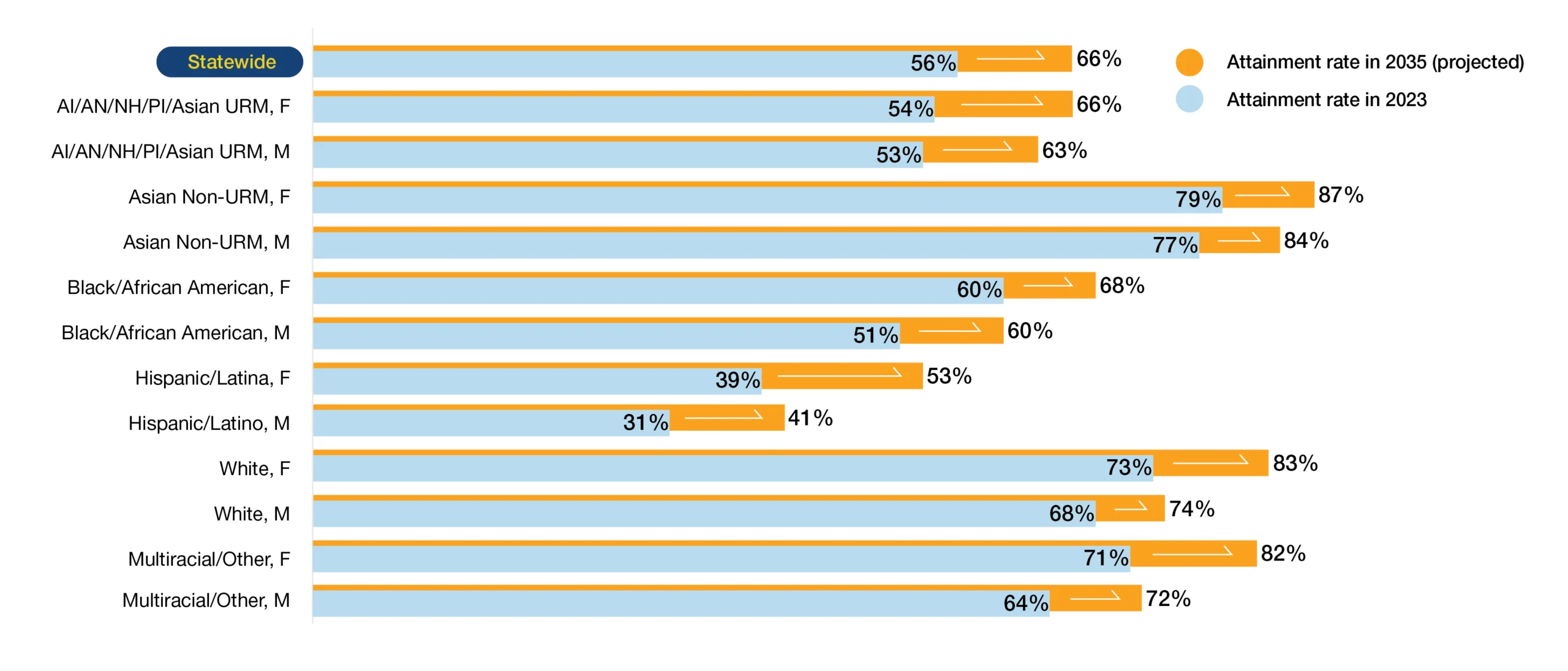
Note: AI = American Indian; AN = Alaska Native; Asian URM (underrepresented minority) = Bhutanese, Cambodian, Hmong, Kazakh, Laotian, Uzbek, and Vietnamese; F = female; M = male; NH = Native Hawaiian; PI = Pacific Islander.
Source: Georgetown University Center on Education and the Workforce analysis of data from the US Census Bureau, American Community Survey (ACS), 2009–23; the US Census Bureau, Survey of Income and Program Participation, 2014 and 2018; and the US Department of Education, Adult Training and Education Survey (ATES), 2016.
Reaching the postsecondary attainment goal will also require increasing attainment rates among low-income Californians and older adults already in the workforce. To achieve the 70 percent target across all underrepresented groups, the attainment rate among older working-age adults would need to increase by 30 percent. Similarly, the attainment rate among low-income Californians would need to more than double the current rate of 33 percent to reach the attainment goal.
Geographic Disparities
California’s diverse geography also shapes attainment patterns. The Bay Area is currently the only region where 70 percent of working-age adults hold postsecondary credentials, although Orange County and the Southern Border are projected to reach this mark by 2035. In contrast, the Northern San Joaquin Valley, the Central San Joaquin Valley, and Kern County have strikingly low postsecondary attainment rates and are projected to lag behind. In regions like these, local economies predominantly depend on agriculture, construction, the service sector, and other hands-on occupations, and it is unclear whether local job markets can provide jobs matched to the education supply if all demographic groups reach a 70 percent postsecondary attainment rate.
Figure 3. Only three regions—the Bay Area, Orange County, and the Southern Border—are on pace to achieve an overall attainment rate of at least 70 percent by 2035.

Source: Georgetown University Center on Education and the Workforce analysis of data from US Census Bureau, American Community Survey (ACS), 2009–23; US Census Bureau, Survey of Income and Program Participation, 2014 and 2018; and US Department of Education, Adult Training and Education Survey (ATES), 2016.
Conclusion
Raising postsecondary attainment rates across all demographic groups in California would drive significant economic growth and mitigate long-standing inequities that have left too many individuals and communities behind. However, CEW’s projections indicate that while 2 million more working-age Californians are likely to hold a postsecondary credential by 2035, an additional 1.84 million adults would need to earn a credential for all demographic groups to reach the 70 percent target. Realizing the promise of a more equitable future in California will only be possible if the state expands access to postsecondary education for underserved populations, supports degree and credential completion, accelerates attainment among younger and older adults alike, and ensures that all regions of the state stand to benefit from a credentialed, skilled workforce.
Downloads
The Golden Ticket: How Raising Postsecondary Attainment Rates to 70 Percent for All Demographic Groups Would Unlock Decades of Prosperity in California finds that achieving at least a 70 percent attainment rate across all demographic groups would require historic public investment and would result in $4.4 trillion in net monetary gains for the state and its residents.
View our other reports

Rethinking Underemployment: Are College Graduates Using Their Degrees?

The Major Payoff: Evaluating Earnings and Employment Outcomes Across Bachelor’s Degrees